
To give you a taste of the book, please enjoy this sample gratis!
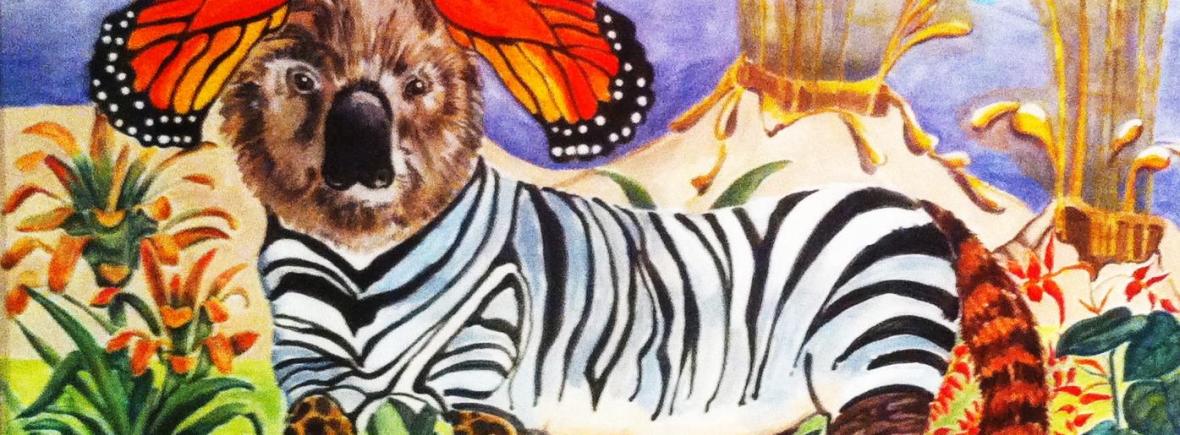
A RECIPE FOR: “Wild & Creative Wonder Beast”* Part II.
* This is a classroom-tested recipe for success.
* This is a “painterly approach” to the “Wild & Creative Wonder Beast” lesson (included in the drawing section).
The Ingredients
18″ x 24″ oaktag paper or any heavyweight art board that is suitable to be painted on, erasers (only if necessary), pencils (for sketching the composition onto the paper), asst. colors of tempera paints (primary colors + black and white), assorted sizes of paintbrushes, containers of water, apron, paint shirts or “coverall”, Day-Glo™, fluorescent, metallic (water base paints) to use for embellishment, polymer, applied as a final touch to enhance the colors and to protect the painting
The Process
Students (child) will use various pictures from books and the picture file, which contain animals, insects, butterflies and moths, reptiles, birds, sea-creatures, etc. as reference when “assembling” the parts that make-up the “beast”.
NOTE: It is essential to have a completed example on hand which will allow for a stimulating discussion, validate the goals of the lesson and motivate the students prior to engaging in the project.
1.) Discussion of the example and sketching the composition
Students will work on 18″ x 24″ oaktag paper and lightly sketch, in pencil, the various components that make up and result in the “Wonder Beast”. Emphasize that stripes, spots or any “characteristics” that add identity of the animal part being depicted need to be included in the sketch. Next, lightly sketch the environment that the “Wonder Beast” would be happy to be in. Since the students are working on a larger sheet of paper, the sketching should be done larger scale, which allows for more freedom thus, making the painting experience less frustrating, more pleasurable and rewarding.
2.) Painting the Composition
Students/child will prepare for the painting activity first, by putting on an art apron or coverall to protect their clothing and then gathering supplies for the project. Since a major emphasis of this lesson is the mixing of colors, students need to be able to mix them with ease.
By covering a tabletop with a clear or white vinyl tablecloth and encouraging/allowing students to mix their colors directly on top of the vinyl is a wonderful way to accomplish the mixing of colors. Students will be enthralled at the notion of being able to mix colors in this manner. If working “one on one” with a student a white vinyl placement or even a white garbage bag could be taped in place on a table or desk and used the same way. Wet paper towels can be used for wiping up leftover colors or if more room is needed for mixing colors on the vinyl. Egg cartons make good containers for the paint and can be placed in zip-lock bags at the end of the session. If students need to mix a larger quantity of a color, the color can be mixed and place in a yogurt container that has been recycled for that purpose. Quite often, even after a large quantity of paint has been mixed, a student runs out of the particular color and STILL NEEDS MORE. No doubt about it, it is a challenge to mix the same, exact color again, but it will test the student’s ability to recall what colors he or she used to make the color and to actually make it again. It might be necessary to refer back to the color wheel. Keeping in mind and following these simple guidelines will help, as well. Colors will be created by mixing the primary colors + black + white. White added to a color makes a tint. Always add a small amount of a color to the white. For example, a “dot” of red added to white makes pink.
Black added to a color makes a shade. Add just a “dot”, very small amount of black to the color you want to darken. A “dot” of black added to blue makes navy blue.
Day-Glo™, fluorescent and water base metallic paints may be used for embellishment. It is necessary to have an assortment of paintbrushes on hand as various sizes of brushes have their own function. Thicker paintbrushes are effectively used to paint large, flat areas, for example, sky and clouds; thinner brushes are used to paint details, such as, stripes, blades of grass, a horse’s tail, etc. Demonstrate the proper way to hold a paintbrush… hold it like a pencil, but not as tight to encourage flexibility with the brush stroke. After all of the painting is completed and DRY, brush a coat of clear polymer over the top. Be sure that when the clear polymer is applied, the brush strokes go in one direction and are overlapped, no rapid back and forth brushwork. THIS CAUSES THE CLEAR TO BECOME FOGGY, A DISASTROUS RESULT.
The OBJECTIVES for the “Wonder Beast” Part II are:
1) To use reference material, such as, the picture file as a motivational means of expression to create a “Wonder Beast”…a creature composed of parts from various animals.
2) To use neat and careful work habits.
3) To follow directions very carefully in order to be successful.
4) To use paint as the media with a growing understanding of mixing various appropriate colors, for example, use of the color wheel.
EVALUATION:
Did the students/child let their imaginations run wild to create the “Wonder Beast”? Were the students/child successful in mixing their colors? Did their “acquired knowledge” and understanding of color prove to be helpful in carrying out the project? Were students neat with regard to their work habits and did they exhibit a responsible attitude in the use of materials and by following directions?
Were the picture file, books, posters, etc. good resources and vital for success with this lesson?
In conclusion, were the final products/artworks dazzling and as a result, very satisfying and successful?
 Recipes for Artfull Success